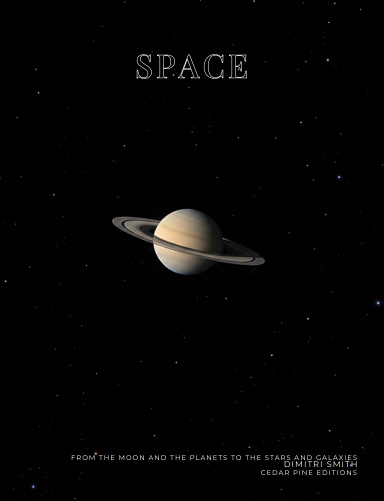
Coffee Table Book of: Space
From the Moon and the Planets to the Stars and Galaxies
Usually printed in 3 - 5 business days
Coffee Table Book of: Space is a large-format coffee table book about space, printed edge to edge in colour, one picture to a page and the widest carried across two. It begins in our own night sky and goes on past the Moon and the planets to the stars and the galaxies beyond.
It opens with the night sky: the Milky Way rising beside tall rock towers, and the zodiacal light, a faint cone of soft white glow above a flat desert. Then the aurora: green curtains over a frozen lake beside snowy spruce, rays meeting high overhead in green and violet, and a deep red aurora above a band of green over snowy peaks.
Then the Moon: a thin crescent, the rest of its disc grey with earthshine, craters seen close along the line between day and night, and the Moon glowing coppery red in a total eclipse.
Then the rocky planets: grey, cratered Mercury, rust-red Mars with its white polar cap, and a small pale Sun setting in a blue glow over a rocky plain on Mars. Then the giants: the cream and brown bands of Jupiter and its great red oval, the rings of Saturn seen close, jets of icy spray rising from a small white moon, and the pale cyan globe of Uranus and the soft blue of Neptune.
Then comets, meteors and asteroids: a comet with a curving pale yellow tail and a straight blue one, meteors streaking out from one point above dark hills, a lumpy grey asteroid, and a polished slice of iron meteorite crossed by interlocking crystals.
Then where stars are born: a cloud of red and pink gas lit by blue-white stars, a single tall, leaning dark column of dust, its tip lit gold, and a glowing disc of dust and gas broken by dark rings.
Toward the end, the galaxies: a spiral seen face-on, its arms of blue stars and pink glowing clouds winding out from a golden core, a barred spiral, a thin edge-on disc split by dark dust, spiral galaxies colliding and pulled out of shape, countless faint galaxies of many shapes and colours, and a lopsided ring galaxy.
Short notes run through the book. They are about space rather than about the pictures: why the Sun and the Moon look almost the same size in the sky, why Venus looks largest as a thin crescent, how far apart the asteroids between Mars and Jupiter really lie, and that planetary nebulae, despite their name, have nothing to do with planets.
Printed in premium colour on heavy 80 lb coated paper at 8.5 x 11 inches, as a hardcover with the art printed on the case.
Details
- Publication Date
- Oct 23, 2026
- Language
- English
- Category
- Science & Medicine
- Copyright
- All Rights Reserved - Standard Copyright License
- Contributors
- By (author): Dimitri Smith
Specifications
- Pages
- 100
- Binding Type
- Hardcover Case Wrap
- Interior Color
- Color
- Dimensions
- US Letter (8.5 x 11 in / 216 x 279 mm)