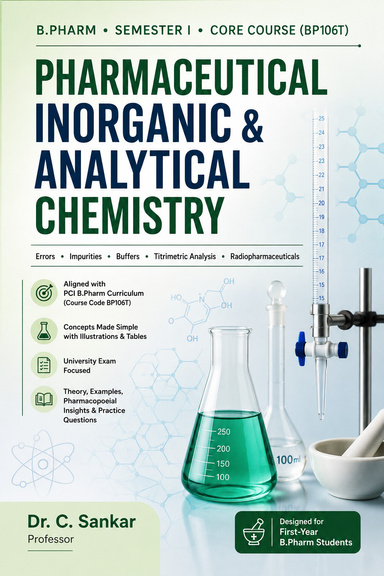
PHARMACEUTICAL INORGANIC & ANALYTICAL CHEMISTRY
This ebook meets accessibility standards and is compatible with assistive technologies. Accessibility compliance is determined by the publisher and creator.
Pharmaceutical Inorganic and Analytical Chemistry sits at the very foundation of the pharmacy curriculum. Long before a student learns to formulate a tablet or dispense a prescription, they must first understand how a substance is confirmed to be what it claims to be — how its purity is verified, how its strength is assayed, and how the inorganic compounds still used widely in therapeutics (antacids, haematinics, radiopharmaceuticals, and antidotes among them) behave chemically. This book has been written to build that foundation clearly, systematically, and in a manner that keeps pace with the classroom.
Over more than two decades of teaching first-year B.Pharm students, I have repeatedly observed that the difference between a student who merely memorises limit-test values and one who genuinely understands pharmaceutical analysis lies in whether the underlying chemistry — of errors, of equilibria, of oxidation and reduction, of chelation — has been properly internalised. Every chapter of this book is therefore built outward from first principles: we begin with why an error occurs before we discuss how to minimise it; we build the buffer equation from the dissociation equilibrium before we apply it to intravenous fluids; we explain why EDTA forms a stable chelate before we use it to assay calcium gluconate.
This edition covers, in full, the five units prescribed under Course BP106T of the Pharmacy Council of India regulations: analytical errors and pharmaceutical impurities; acid-base chemistry, buffers and electrolytes; the major families of titrimetric analysis (acid-base, non-aqueous, precipitation/gravimetric, complexometric, and redox); the gastrointestinal agents and radiopharmaceuticals of Unit IV; and the miscellaneous inorganic compounds of Unit V — expectorants, emetics, haematinics, and antidotes. Wherever the syllabus specifically names a compound for assay (marked with an asterisk in the detailed syllabus), this book gives the assay principle and, where useful, the outline reaction.
Details
- Publication Date
- Aug 18, 2026
- Language
- English
- Category
- Education & Language
- Copyright
- All Rights Reserved - Standard Copyright License
- Contributors
- By (author): Dr.C.Sankar Professor
Specifications
- Format
- EPUB