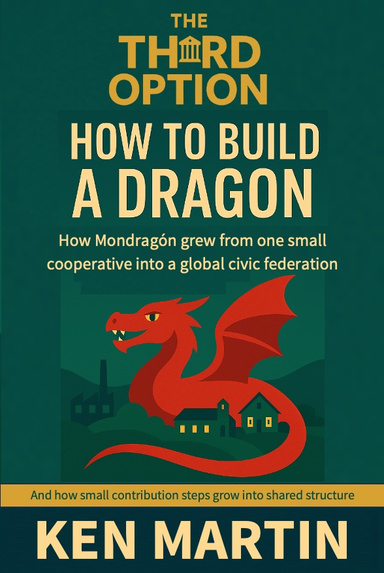
How To Build a Dragon
A Third Option Mini Guide
This ebook may not meet accessibility standards and may not be fully compatible with assistive technologies.
HOW TO BUILD A DRAGON
Contribution sits in a strange place in public debate. People hear the word and think kindness. They picture volunteers helping for an hour or small gestures that soften a moment. Helpful, yes, but limited. Contribution is different. It becomes structural when you treat it as capability, not charity.
Mondragón proved this. Five young workers and a priest started with the smallest steps. They fixed one problem. They built one routine. They shared one piece of proof. Those steps linked into a cooperative. The cooperative linked into others.
Over time, this became a global federation with thousands of workers, shared ownership, stable governance, internal finance, and a culture built on shared responsibility.
None of this came from kindness. It came from contribution treated as a productive force. Clear routines. Shared rules. Visible proof. Reinvestment. People learning by doing. Capability compounding across spaces.
Contribution follows a simple definition. You improve one shared element. The improvement is visible. The change reduces pressure or grows capability for more than one person. This is why it scales. It is measurable, teachable, and portable.
Mondragón also shows why this approach still works. Its method did not depend on a moment in history. It relied on human behaviour. Simple routines. Shared decisions. Steady reinvestment. Capability before expansion. These principles apply in schools, neighbourhoods, workplaces, and digital groups today.
Parkrun shows the same pattern. It began with thirteen runners in one London park. Low friction entry. Visible proof. Repeatable steps. Shared identity. It grew into a global network because the routine stayed simple and people copied it. This is the same engine that powered Mondragón.
If you treat contribution as soft, it stays small. If you treat contribution as a practical engine, it scales. It shapes identity. It builds structure. It gives people real power. It offers communities options when political systems stall.
Mondragón is not a sentimental story. It is a design pattern. It shows how capability grows through repeated action. You start with one friction. You fix it in a repeatable way. You share the result. You watch for the first copy. You link the groups that follow.
Kindness helps people. Contribution strengthens systems. The future needs both, but only one builds something that lasts.
Details
- Publication Date
- Dec 6, 2025
- Language
- English
- Category
- Business & Economics
- Copyright
- All Rights Reserved - Standard Copyright License
- Contributors
- By (author): Ken Martin
Specifications
- Format