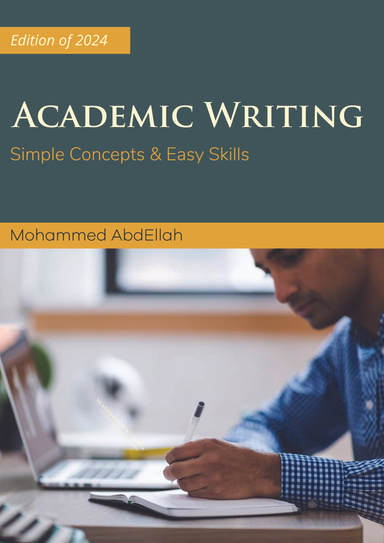
Academic Writing: Simple Concepts & Easy Skills
Edition of 2024
This ebook may not meet accessibility standards and may not be fully compatible with assistive technologies.
This book is aimed at undergraduate and postgraduate international students and researchers who need to improve their academic writing skills.
Book Structure:
Introduction: Briefly introduces the importance of strong academic writing skills.
Chapter One: The Academic Language
Defines academic vocabulary and its importance.
Breaks down key elements like nouns, verbs, adjectives, adverbs, collocations, and idioms, providing examples relevant to academic writing.
Explains generic terms, hedges, and boosters, and how they are used to convey specific tones and arguments.
Covers essential academic grammar points, focusing on sentence structure, depersonalization (passive voice and nominalization), reported speech, referring verbs, and cohesive devices (transition words and phrases).
Chapter Two: The Features of Academic Writing
Defines and explains the key characteristics of academic writing: formality, objectivity, precision, evidence-based approach, structure, cohesion, coherence, and unity.
Discusses the importance of ethical considerations in academic writing. Explore core values like honesty, transparency, and fairness.
Explains different forms of academic misconduct like plagiarism, ghostwriting, collusion, and the use of AI text generators.
Chapter Three: The Genres of Academic Writing
Provides an overview of various academic writing genres with clear definitions and purposes, including book reviews, case studies (descriptive, explanatory, exploratory, critical, collective, intrinsic), literature reviews, research proposal, research paper, essay (expository, descriptive, compare and contrast, argumentative, cause and effect), conference paper, and lab report.
Chapter Four: The Writing Process
Guides readers through the stages of academic writing: prewriting, writing, and post-writing.
Prewriting: Explain effective strategies for gathering data and information (distinguishing data and information, various data gathering methods, and information collecting tools and techniques). Include information evaluation techniques.
Writing: Focuses on sentence structure, including the function of topic sentences and supporting sentences. Explain the concept and construction of a thesis statement. Provide guidance on writing different sections of an academic paper like the introduction, body paragraphs, conclusion, and summary.
Post-writing: Discuss effective revision strategies and the difference between editing and proofreading.
Details
- Publication Date
- Jul 9, 2024
- Language
- English
- Category
- Education & Language
- Copyright
- All Rights Reserved - Standard Copyright License
- Contributors
- By (author): Mohammed AbdEllah
Specifications
- Format