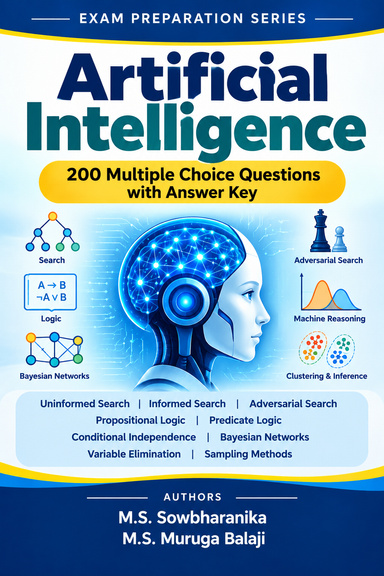
Artificial Intelligence Search, Logic & Reasoning
200 Multiple Choice Questions with Answer Key
ByMS SowbharanikaMS Muruga Balaji
This ebook may not meet accessibility standards and may not be fully compatible with assistive technologies.
How do machines explore state spaces, evaluate complex games, deduce truth from formal logic, and reason through real-world uncertainty? Artificial Intelligence: Search, Logic & Reasoning provides an intensive, question-driven workbook designed to test, reinforce, and solidify your theoretical and mathematical mastery of foundational AI. Covering the core syllabus of undergraduate and postgraduate computer science programs, this book balances definitional principles, algorithmic properties, asymptotic complexities, and short numerical deductions. Every question is followed by a clear, single-choice answer key, allowing you to self-evaluate and target weak areas effectively. Topics Covered Across 9 In-Depth Chapters:Foundations & Intelligent Agents: Rationality concepts, PEAS classification, environment topologies (deterministic, stochastic, fully observable), and agent architectures. Uninformed (Blind) Search: Mechanics, frontiers (LIFO/FIFO), completeness, optimality, and time/space complexities of BFS, DFS, UCS, DLS, and IDDFS. Informed (Heuristic) Search: $A^*$ search dynamics, admissible and consistent heuristics, dominance, Greedy Best-First Search, Weighted $A^*$, and local optimization (Hill Climbing, Simulated Annealing, Genetic Algorithms). Adversarial Search & Games: Minimax mechanics, Game Trees, Alpha-Beta pruning criteria and cutoff savings, Horizon Effect, Quiescence Search, and Expectimax for chance nodes. Propositional Logic: Truth tables, model validity, satisfiability, logical equivalences, De Morgan's laws, Horn clauses, resolution refutation, forward chaining, and backward chaining. Predicate (First-Order) Logic: Universal ($\forall$) and existential ($\exists$) quantifiers, terms, predicates, unification (MGU), occurs-check, Skolemization, and CNF transformation. Bayesian Networks & Conditional Independence: Probability axioms, Bayes' rule, Directed Acyclic Graph (DAG) structures, conditional independence, d-separation rules (chains, forks, colliders), explaining away, and Markov blankets. Exact Inference: Variable elimination mechanics, pointwise factor multiplication, summing out, evidence restriction, barren nodes, elimination ordering, and treewidth complexity. Approximate Inference (Sampling): Direct/prior sampling, rejection sampling, likelihood weighting, Markov Chain Monte Carlo (MCMC), Gibbs sampling, burn-in periods, and convergence error bounds. Special Preparation Features:Complete Answer Key: Fully ve
Details
- Publication Date
- Oct 8, 2026
- Language
- English
- Category
- Computers & Technology
- Copyright
- All Rights Reserved - Standard Copyright License
- Contributors
- By (author): MS Sowbharanika, By (author): MS Muruga Balaji
Specifications
- Format
Keywords
artificial intelligence MCQ questions and answersAI search algorithms A star minimax alpha betapropositional predicate logic first order logicBayesian networks conditional independence d sepexact inference variable elimination sampling AIcomputer science gate AI exam prep test bankintelligent agents uninformed informed search guide