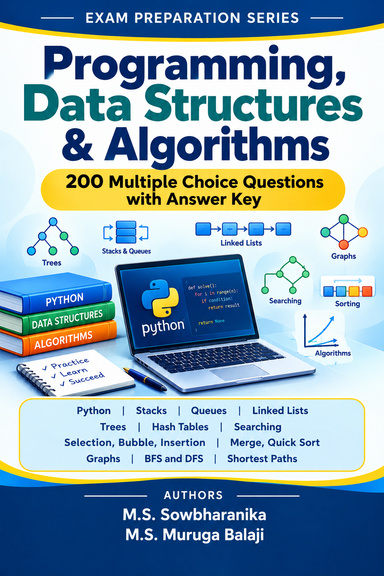
Programming, Data Structures & Algorithms
200 Multiple Choice Questions with Answer Key
ByMS SowbharanikaMS Muruga Balaji
This ebook may not meet accessibility standards and may not be fully compatible with assistive technologies.
Clean code and optimal performance depend directly on selecting the right data structures and understanding algorithmic complexity. Programming, Data Structures & Algorithms delivers 200 carefully graded, multiple-choice questions designed to test both conceptual fundamentals and practical tracing skills across modern computing syllabi. Covering Python syntax nuances, classical memory structures, and advanced graph traversals, this book progresses from foundational definitions to asymptotic derivations and step-by-step code simulations. Every question includes a single unambiguous answer, enabling efficient self-study, diagnostic evaluation, and rapid revision. Topics Covered Across 12 Comprehensive Chapters:Programming in Python: Data types, slice notation, immutability, list comprehensions, exception handling, lambda functions, and dictionary lookups. Algorithm Analysis & Complexity: Big-O asymptotic upper bounds, growth rates, nested loops, best/worst-case limits, and recurrence relations. Stacks & Queues: LIFO/FIFO principles, infix-to-postfix translation, expression evaluation, balanced bracket matching, and circular queues. Linked Lists: Singly, doubly, and circular linked structures, pointer manipulation, Floyd’s cycle detection, and reversal techniques. Trees & Heaps: Binary tree traversals (inorder, preorder, postorder, level-order), BST operations, AVL balance factors, and array-based binary heaps. Hash Tables: Hash functions, separate chaining, open addressing (linear probing), load factors, and primary clustering. Searching Algorithms: Linear search, binary search recurrence and edge conditions, jump search, and interpolation search. Basic Sorting: Selection sort, bubble sort with early exit, and insertion sort, including stability, swap counts, and inversion limits. Divide & Conquer: Merge sort mechanics, recurrence analysis, quick sort partitioning (Lomuto), and pivot selection strategies. Graph Theory Foundations: Vertices, directed/undirected edges, degree handshaking theorems, adjacency matrices vs. adjacency lists, and DAG properties. Graph Traversals: Breadth-First Search (BFS), Depth-First Search (DFS), cycle detection, connected components, and topological sorting. Shortest Path Algorithms: Dijkstra's greedy algorithm with min-heaps, Bellman-Ford negative edge detection, and Floyd-Warshall all-pairs dynamic programming. Assessment & Revision Tools:Verified Answer Key: Instant, authoritative answers for every
Details
- Publication Date
- Oct 8, 2026
- Language
- English
- Category
- Computers & Technology
- Copyright
- All Rights Reserved - Standard Copyright License
- Contributors
- By (author): MS Sowbharanika, By (author): MS Muruga Balaji
Specifications
- Format
Keywords
data structures algorithms MCQ questions answersPython programming multiple choice practice testbinary search trees heaps AVL tree questions banksorting algorithms quick sort merge sort practicegraph theory BFS DFS Dijkstra shortest path testcomputer science technical coding interview prepstack queue linked list hash table exam guide