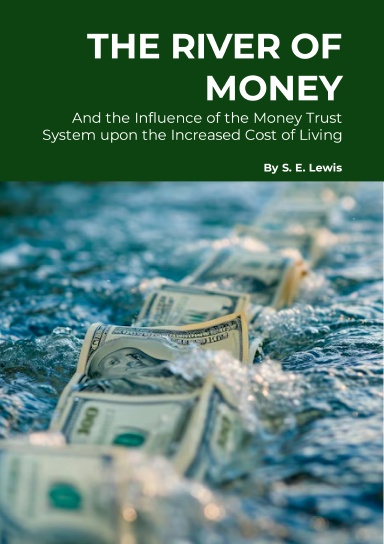
The River of Money
And the Influence of the Money Trust System upon the Increased Cost of Living
Usually printed in 3 - 5 business days
In The River of Money, S. E. Lewis paints a vivid picture of America’s financial life as if it were a great current, flowing ceaselessly through banks, trust companies, and markets. At first glance, this river seems to nourish the nation—funding farms, factories, and trade—but Lewis invites the reader to look closer. The current, he warns, is no longer free; it is dammed and diverted by a small, interlinked circle of financiers who decide where and when the water will flow.
He traces how these men, bound together by stockholdings, directorships, and private agreements, have learned to steer the river for their own gain. Credit is released or withheld at their pleasure, prices rise in the wake of their maneuvers, and the cost of living swells like a flood downstream. Ordinary citizens feel the pressure without ever seeing the hands on the sluice gates.
Lewis’s tone is urgent but not hopeless. He calls for the river to be set free again—through laws that break monopolistic control, through transparency that lets the public see who holds the levers, and through a political will strong enough to resist the undertow of moneyed influence. In his telling, the “river of money” is not just an economic metaphor; it is the lifeblood of the republic, and its course will shape the fate of all who live along its banks.
Details
- Publication Date
- Sep 4, 2025
- Language
- English
- Category
- Business & Economics
- Copyright
- Creative Commons NonCommercial, NoDerivatives (CC BY-NC-ND)
- Contributors
- By (author): S. E. Lewis
Specifications
- Pages
- 76
- Binding Type
- Paperback Perfect Bound
- Interior Color
- Black & White
- Dimensions
- A5 (5.83 x 8.27 in / 148 x 210 mm)