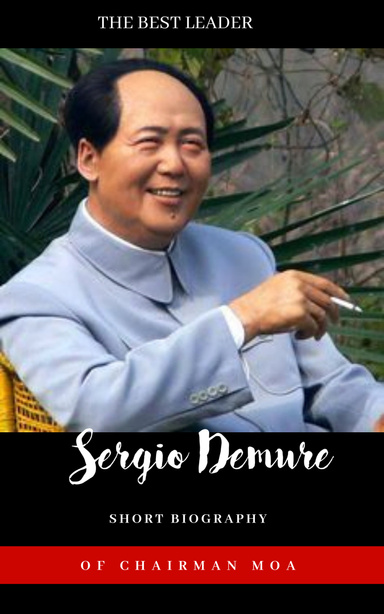
CHAIRMAN MAO
This ebook may not meet accessibility standards and may not be fully compatible with assistive technologies.
Chairman Mao Zedong’s autobiography offers a unique perspective on the life and times of one of the most influential figures in modern history. As the founder of the People’s Republic of China, Mao shaped the course of Chinese politics and society through his leadership of the Communist Party, his vision of Marxist-Leninist ideology, and his controversial policies, which include the Great Leap Forward and the Cultural Revolution. His autobiography, which provides insight into his personal experiences, ideas, and the historical context of his rise to power, is a key resource for understanding the complexities of his leadership and the impact of his decisions on China and the world.
Born in 1893 in Shaoshan, a small village in Hunan Province, Mao Zedong grew up in a peasant family. His early life was shaped by traditional Chinese culture, but his experiences with the injustices of the imperial system and the hardships faced by the Chinese people inspired him to seek change. In his autobiography, Mao reflects on his youth, describing his education, the influence of his father, and the intellectual awakening that led him to Marxist thought. He often emphasized the importance of peasant support in the revolution, seeing the rural population as the primary force for social and political change, a viewpoint that would guide his later policies.
Mao’s political career began in the early 1920s when he became involved in the Chinese Communist Party (CCP). He was one of the key leaders who helped transform the party into a formidable political force. His rise to prominence coincided with the tumultuous period in Chinese history, marked by the collapse of the Qing Dynasty, the Warlord Era, and the struggle between the Nationalist Kuomintang (KMT) and the Communists. Mao’s autobiography sheds light on the ideological and strategic battles within the CCP, where he emerged as a leader advocating for a rural-based revolution, contrasting with the urban-centered strategy promoted by many of his contemporaries.
The Long March (1934-1935), a grueling retreat undertaken by the Red Army to escape the KMT’s encirclement, was a turning point in Mao’s life and leadership. His autobiography reflects on this event as both a military and a symbolic victory, which solidified his authority within the Communist Party. During the Long March, Mao’s ability to inspire his troops and maintain unity under extreme conditions earned him the loyalty of his comrades. It was during this time t
Details
- Publication Date
- Dec 29, 2024
- Language
- English
- Category
- Biographies & Memoirs
- Copyright
- Creative Commons NonCommercial (CC BY-NC)
- Contributors
- By (author): Sergio Demure
Specifications
- Format