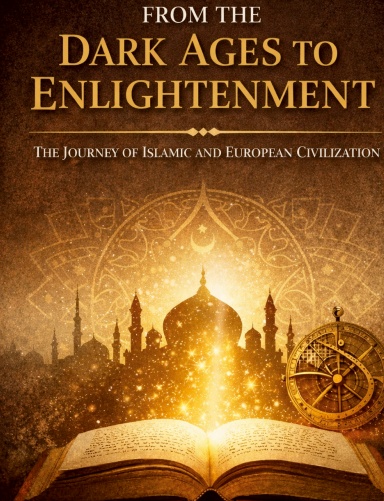
Civilizations rise and fall not merely through military power or economic wealth, but through the strength of their ideas, moral foundations, and commitment to knowledge. History demonstrates that intellectual awakening is the true engine of lasting progress. This publication examines one of the most significant transformations in human history: the emergence of Islamic civilization from pre-Islamic Arabia, its rise into a global center of learning and scientific leadership, its later decline, and the modern effort among Muslim societies to rebuild knowledge-based futures.
Before the revelation of the Qur’an, Arabia was fragmented by tribal conflict, social inequality, and moral instability. There existed no unified ethical framework, no centralized educational institutions, and no sustained tradition of scientific inquiry. The Qur’an introduced a revolutionary worldview — one that elevated knowledge to a sacred duty, replaced tribal superiority with universal moral responsibility, and established justice, accountability, and social cohesion as foundations of civilization.
The first revealed command, “Read,” signaled that faith and intellect were not separate pursuits. Throughout the Qur’an, reflection upon nature, reasoned thought, and the pursuit of understanding are presented as acts of worship. This spiritual orientation toward knowledge produced a culture in which scholarship flourished. Universities, hospitals, libraries, observatories, and translation centers emerged across the Muslim world, preserving and expanding human knowledge and laying the groundwork for the later European Renaissance.
This publication also examines how historical disruptions — including invasions, political fragmentation, economic shifts, and colonial domination — altered the global balance of power. The consequences of these transformations remain visible today in patterns of global inequality, technological disparity, and uneven development. Understanding this history is not an exercise in blame, but an essential step toward building equitable and sustainable futures.
At the same time, the modern revival of scientific investment in several Muslim-majority countries demonstrates that decline is not destiny.
Details
- Publication Date
- Feb 5, 2026
- Language
- English
- Category
- Religion & Spirituality
- Copyright
- All Rights Reserved - Standard Copyright License
- Contributors
- By (author): Yahya Muldrow
Specifications
- Pages
- 44
- Binding Type
- Hardcover Case Wrap
- Interior Color
- Color
- Dimensions
- US Letter (8.5 x 11 in / 216 x 279 mm)